
The world we live in is much more than mountains, rivers, and oceans—it is a dynamic stage where billions of human lives intersect with the physical environment. While physical geography explains rainfall, soil, and tectonic processes, human geography explores why people live where they do, how they adapt to surroundings, and how societies organize themselves in space.
Understanding the human geography definition is key to comprehending social, economic, cultural, and political patterns that shape our daily lives. This article provides a comprehensive guide to the meaning, scope, and importance of human geography for students, professionals, and anyone interested in the human footprint on Earth.
What is Human Geography?
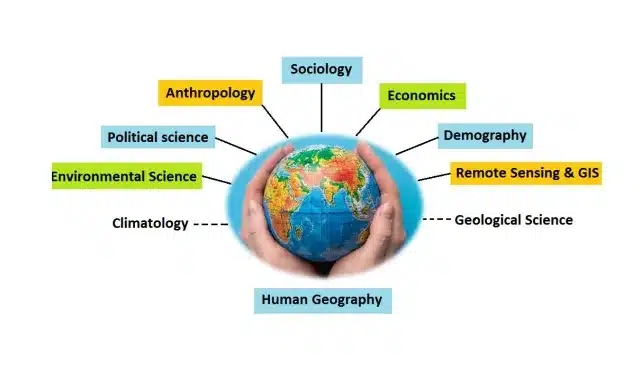
At its core, human geography is the study of human societies and their spatial relationships with the environment. It seeks to answer the “where” and “why” of human activities:
- Why do people migrate from rural areas to cities?
- Why are some nations wealthier than others?
- How do languages, religions, and cultures spread across the globe?
By analyzing patterns of population, culture, economy, and politics, human geographers create a map of civilization itself, revealing hidden structures in the seemingly chaotic human landscape.
Core Definition of Human Geography
The human geography definition focuses on the study of people, communities, and their interactions with space. Unlike physical geography, which examines natural processes like rivers or mountains, human geography studies the “humanized” Earth—places and regions shaped by human activity.
Historically, scholars believed in environmental determinism, assuming that human behavior is dictated solely by the physical environment. Modern geographers embrace possibilism, which recognizes that while the environment imposes limitations, human geography definition creativity, culture, and technology ultimately shape outcomes. In essence, humans influence the land as much as the land influences humans.
Why Human Geography Matters
Understanding human geography definition is not just an academic exercise—it is essential for addressing modern challenges:
- Urban Planning: Designing cities for optimal transportation, housing, and public services.
- Economic Development: Understanding regional disparities and planning infrastructure investments.
- Climate Response: Mapping populations at risk from sea-level rise or extreme weather events.
- Global Health: Tracking the spread of diseases and evaluating healthcare accessibility.
By combining sociology, economics, politics, and environmental science, the human geography definition provides a spatial lens to analyze complex human-environment interactions.
Human Geography as an Interdisciplinary Field
human geography definition is inherently interdisciplinary, synthesizing knowledge from:
- Sociology: Examining social behavior and community structures.
- Economics: Understanding production, trade, and resource distribution.
- Political Science: Studying governance, boundaries, and power.
- History: Exploring cultural evolution over time.
This integration allows geographers to interpret human geography definition activity not as isolated events but as patterns connected across space and time.
Physical vs. Human Geography
| Feature | Physical Geography | Human Geography |
| Primary Focus | Natural processes and the environment | Human activities and social structures |
| Key Subjects | Climate, landforms, water, soil | Culture, population, economy, urbanization |
| Objective | Understand Earth’s natural systems | Understand how humans organize space |
| Example Question | How do volcanoes form? | How does city layout affect economic growth? |
| Tools Used | Geology, Meteorology, Biology | Sociology, Economics, GIS, Political Science |
This comparison clarifies how human geography complements physical geography while focusing on the human experience.
Scope of Human Geography
Human geography covers almost every aspect of human geography definitionexistence and is divided into key subfields:
1. Population Geography
Population geography examines where people live, how populations grow, and how they migrate. Current issues include:
- Aging populations in Europe and Japan.
- Youth bulges in Africa and South Asia.
- Migration patterns due to conflict, economic opportunity, or climate change.
This subfield is vital for planning healthcare, education, housing, and urban infrastructure.
2. Cultural Geography
Cultural geography studies human cultures and their spatial imprint on the environment. Examples include:
- Distribution of religions and languages.
- Architecture and city designs reflecting cultural values.
- Festivals, markets, and cultural landscapes defining regions.
Cultural geographers explore how traditions and social norms shape human interactions with the environment.
3. Economic Geography
Economic geography examines how people make a living and distribute resources. Key questions include:
- Why do some regions industrialize while others remain agrarian?
- How do trade networks connect countries globally?
- How does the digital economy create new geographic inequalities?
This subfield links spatial patterns to economic outcomes, guiding policy and business strategy.
4. Political Geography
Political geography studies power, boundaries, and governance in space:
- Geopolitics and the influence of location on national strategy.
- Electoral geography and voting patterns.
- International borders, territorial disputes, and sovereignty issues.
Understanding political geography helps explain conflicts, alliances, and global power dynamics.
5. Urban Geography
Urban geography examines cities, their structures, and human behavior:
- Gentrification and urban renewal.
- Suburban sprawl and transportation networks.
- Smart cities using AI and data to manage resources efficiently.
With over half of the world’s population in cities, urban geography is essential for sustainable urban development.
Human-Environment Interaction
A central theme in human geography definition is how humans interact with their environment:
- Environmental Determinism: The outdated view that environment dictates culture.
- Possibilism: Humans adapt creatively to environmental constraints.
- Cultural Ecology: Studies how specific cultures develop sustainable environmental practices.
Example: Indigenous Amazonian communities manage forests in ways that preserve biodiversity, reflecting cultural adaptation to local ecosystems
Historical Evolution of Human Geography
- Ancient Greece: Eratosthenes coined the term “geography.”
- Age of Discovery: Focused on mapping lands for trade and conquest.
- 19th–20th Century: Carl Sauer emphasized cultural landscapes and human-environment interaction.
- Late 20th Century: The Quantitative Revolution introduced computer modeling and GIS.
- 21st Century: Critical Geography examines social justice, race, and gender in spatial contexts.
Modern Tools in Human Geography
Technology has transformed human geography into a data-driven science:
- Geographic Information Systems (GIS): Overlaying population, income, infrastructure, and environmental data to reveal patterns like food deserts.
- Remote Sensing: Satellites and drones track urban growth, human movement, and environmental changes in real time.
These tools support urban planning, disaster management, and business strategy.
Challenges Facing Human Geographers
Human geographers today face unprecedented challenges:
- Climate Change: Sea-level rise, desertification, and extreme weather threaten human geography definition settlements.
- Globalization: Unique local cultures risk homogenization; geographers study “placelessness.”
- Urban Overcrowding: Megacities struggle with infrastructure, housing, and services.
- Migration and Refugees: Tracking displaced populations is increasingly important.
Simple Explanation: Why Human Geography Matters
Human geography explains your “place” in the world:
- Why your city exists where it does.
- Why languages, foods, and traditions vary regionally.
- How global supply chains deliver products to your doorstep.
- Even using a GPS involves human geography definition geography principles, reflecting population density, economic demand, and urban planning.
Conclusion
The human geography definition extends far beyond memorizing capitals or landmarks. It is a dynamic discipline that explores the human geography definition footprint on Earth, helping address social inequality, environmental sustainability, and urban planning.
As the world becomes more interconnected, human geography definition geography provides the framework to understand complex, interwoven patterns of human life, guiding decisions in social justice, economics, and environmental conservation.
FAQs
Q1: What is the simplest definition of human geography?
A: Human geography is the study of how humans interact with the Earth, organize societies across space, and adapt environments.
Q2: How is human geography different from sociology?
A: Sociology examines human behavior, while human geography adds a spatial dimension, analyzing where activities occur and their environmental influences.
Q3: What are the five themes of geography?
A: Location, Place, Human-Environment Interaction, Movement, and Region.
Q4: Is human geography a science?
A: It is a social science, but it uses scientific methods, data analysis, and GIS technology.
Q5: Why is “place” important in human geography?
A: A place is a location imbued with human meaning, such as a home versus just an address.
Q6: How can human geography help businesses?
A: Through geomarketing, helping companies choose store locations based on population, income, and competition.
Q7: What is a cultural landscape?
A: A cultural landscape is the imprint of human activity on the environment, including cities, farmland, and historical monuments.
Q8: How does human geography address climate change?
A: By mapping populations at risk, planning resilient cities, and studying adaptive strategies in vulnerable regions.
Q9: How does technology enhance human geography?
A: Tools like GIS, remote sensing, and drones enable geographers to analyze, visualize, and predict human-environment patterns.
Q10: Can human geography explain migration patterns?
A: Yes. It studies the causes, routes, and impacts of human migration, including economic, environmental, and political factors.
Related posts:
 भूगोल का जनक कौन है? – Father of Geography in Hindi
 भारत के प्रमुख दर्रे | Important Mountain Passes of India in Hindi
 Agricultural Geography: The Study of Agriculture’s Role in Geography and Environment
 ICAI Exams Postponed in Punjab and Jammu Due to Floods
 ITR Filing Deadline 2025 Updates for Taxpayers
 Asus TUF A17 Gaming Laptop Price, Specs, and Performance
 Mastering First Aid: Essential Skills for Any Sudden Crisis
 How to Check TS TET Result 2025 Online – Easy Step-by-Step Guide